
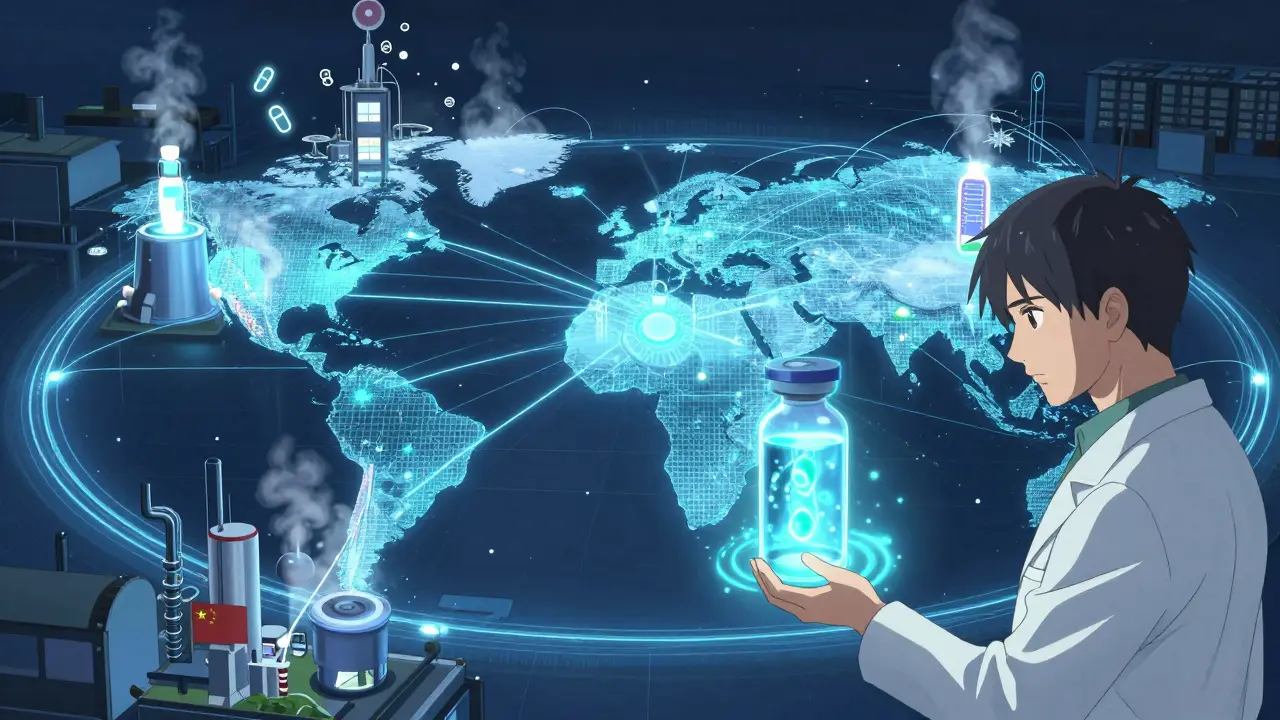
The global generic drug market isn’t just surviving-it’s evolving. As healthcare systems buckle under rising costs and aging populations, cheap, effective medicines have become the backbone of public health. But the future won’t look like the past. By 2030, the market will be shaped by new players, tougher regulations, and a shift from simple pills to complex biological therapies. If you’re wondering how generic drugs will stay relevant, the answer isn’t just about price anymore-it’s about capability, control, and collaboration.
Why Generics Still Matter More Than Ever
Generic drugs are the reason millions can afford insulin, blood pressure meds, and antibiotics. They’re not knockoffs. They’re identical in active ingredients, dosage, and effectiveness to brand-name drugs-but cost 80-85% less. In the U.S., generics make up 90% of prescriptions but only 23% of spending. In Germany, nearly 72% of prescriptions are for generics. In Italy? Just 28%. That gap isn’t random. It’s policy. Countries that push generics save billions. The World Health Organization estimates global healthcare spending hit $9.8 trillion in 2024. Without generics, that number would be nearly $3 trillion higher.
Patents on major branded drugs expired in 2024 alone, freeing up $70 billion in potential generic sales. That’s a flood of opportunity. But here’s the twist: the low-hanging fruit is gone. The easy targets-like statins and metformin-are already crowded. The next wave? Biosimilars. These are generic versions of biologic drugs-complex, injectable medicines used for cancer, autoimmune diseases, and diabetes. They’re not simple to copy. They require 10-20 times more manufacturing steps than a traditional pill. Development costs? $100-250 million. Compare that to $1-5 million for a regular generic. That’s why only big players can enter this space now.
Who’s Driving Growth? The Rise of Pharmerging Markets
North America and Western Europe aren’t shrinking, but they’re slowing. Price controls, strict regulations, and buyer consolidation mean generic profits are thinning. In 2024, average margins dropped to 12%, down from 18% in 2020. Growth isn’t happening there. It’s happening in the pharmerging markets: India, China, Brazil, Turkey, Saudi Arabia, and Egypt.
India produces over 60,000 generic medicines and supplies 20% of the world’s generic volume by volume. China makes 40% of the world’s active pharmaceutical ingredients (APIs)-the raw building blocks of pills. Together, they control about 35% of global manufacturing capacity. But it’s not just about production. These countries are building demand too. India’s National Pharmaceutical Pricing Authority keeps prices low. China’s “Healthy China 2030” pushes universal access. Saudi Arabia’s Vision 2030 is investing billions to build local pharma infrastructure. Egypt now requires 50% of essential medicines to be made locally by 2025.
These markets aren’t just consuming generics-they’re making them better. The Asia-Pacific region is growing at 9.66% CAGR from 2025 to 2030. That’s more than double the pace of the U.S. and Europe. By 2025, these countries will add $140 billion in new medicine spending. That’s the real engine of the future.
The Biosimilar Revolution
The biggest shift in the generic market isn’t about more pills. It’s about better, more complex drugs. Biosimilars are the fastest-growing segment, projected to grow at 12.3% annually through 2030. Why? Because biologics are expensive. A single course of a branded biologic for rheumatoid arthritis can cost $30,000 a year. A biosimilar? Around $20,000. That’s still a big price tag-but it’s 15-30% cheaper. That’s the new normal.
Companies that stuck to small-molecule generics are struggling. The margins are too thin. The competition too fierce. But biosimilars? They’re a different game. They need clean rooms, sterile environments, advanced analytics, and deep scientific expertise. That’s why big pharma players like Sandoz, Amgen, and Pfizer are dominating. But it’s also opening doors for Indian and Chinese firms with the capital to invest. Dr. Sarah Thompson of KPMG put it bluntly: “Manufacturers must become bigger, eliminate middlemen, or build new service models-or get left behind.”
It’s not just about making the drug. It’s about proving it works the same way. Regulatory agencies demand extensive clinical data. The FDA and EMA don’t accept shortcuts. That’s why only 12% of global generic manufacturers are even trying to enter the biosimilar space.
Quality Control: The Hidden Crisis
Here’s something you don’t hear often: 40% of FDA warning letters in 2023 were aimed at foreign generic manufacturers. That’s not a small number. It’s a red flag. In 2023 alone, the FDA issued 187 warning letters to factories in India, China, and elsewhere for issues like data manipulation, poor sanitation, and unapproved process changes. These aren’t hypothetical risks. They’re real. In 2022, contaminated heparin from China led to dozens of deaths in the U.S. That’s why countries like Saudi Arabia and the UAE are tightening their own regulations-not just to protect their citizens, but to attract serious buyers.
Buyers-hospitals, insurers, governments-are getting smarter. They’re asking for certificates of analysis. They’re auditing factories. They’re moving away from the cheapest bidder to the most reliable one. Quality isn’t optional anymore. It’s the new price point.
The Supply Chain Tightrope
China supplies 65% of the world’s APIs for generic drugs. That’s a massive dependency. What happens if trade tensions spike? If a factory shuts down due to pollution controls? If a pandemic hits again? The global supply chain is fragile. That’s why India’s government poured $1.34 billion into its Production Linked Incentive (PLI) scheme in 2024-to build domestic API production. The EU is doing the same. The U.S. is pushing for “friend-shoring”-moving supply chains to trusted allies like India and Vietnam.
But building API plants takes years. And billions. It’s not a quick fix. So for now, the world still leans on China. But the writing’s on the wall: diversification isn’t a choice. It’s survival.
What’s Next? The 2030 Outlook
By 2030, the global generic market will hit $689 billion, according to ForInsights Consultancy. But here’s the catch: generics will make up a smaller share of total drug sales. In 2024, they accounted for 57.56% of pharmaceutical revenue. By 2030, that could drop to 53%. Why? Because specialty drugs-GLP-1 weight-loss meds, gene therapies, CAR-T cancer treatments-are booming. They’re expensive, complex, and patented. They’re eating into the generic space.
So the future isn’t about replacing all branded drugs. It’s about replacing the right ones. Generics will dominate chronic disease treatment-diabetes, hypertension, asthma, depression. They’ll be the workhorses of public health. But for cutting-edge cancer drugs or rare disease treatments? Biosimilars and specialty generics will lead.
Manufacturers who succeed will be those who combine scale with specialization. They’ll invest in biosimilars. They’ll build quality systems. They’ll partner with local governments. They’ll stop competing on price alone and start competing on reliability, speed, and innovation.
The era of the low-cost, high-volume generic manufacturer is ending. The era of the smart, regulated, technically advanced pharmaceutical partner is just beginning.


Reviews
So India makes 60k generics and 20% of global volume? That’s wild. We got a tiny pharma plant in Hyderabad that ships to 80 countries and my cousin works there-she says they’re building new clean rooms faster than the gov can approve them. Also, the API stuff? Half the labs here still use manual logs. Hope they fix that before the FDA comes knocking again.
Let’s be real-this whole ‘generic revolution’ is a distraction. Big Pharma just moved the goalposts. Biosimilars? They’re just branded drugs with a new label and a 15% discount. The real story? The FDA’s warning letters are a PR stunt. They know 90% of the factories are fine-they just need an excuse to keep pushing American-made drugs that cost 10x more. Wake up.
China’s 65% API dominance isn’t just economic-it’s geopolitical. You think the U.S. is ‘friend-shoring’? That’s code for ‘we’re terrified of being cut off.’ Meanwhile, India’s PLI scheme is the smartest move since the moon landing. But here’s the kicker: no one’s talking about the labor conditions in those API plants. You want cheap medicine? Someone’s paying for it-with their lungs.
It’s fascinating how the market is shifting from volume to value-not just in pricing, but in systemic reliability. The rise of biosimilars isn’t merely technological; it’s a redefinition of pharmaceutical integrity. We’re moving from a commodity-based model to a quality-as-brand paradigm. And yet, the regulatory frameworks haven’t caught up. The FDA, EMA-they’re still operating on 2005-era protocols. The gap between innovation and oversight is widening-and it’s dangerous.
Oh please. You call this ‘evolution’? It’s just capitalism repackaging exploitation. ‘Quality isn’t optional anymore’-sure, until a hospital in rural Texas still buys the cheapest bid because their budget got slashed. The ‘smart, regulated, technically advanced’ manufacturers? They’re still owned by the same billionaires who made billions off brand-name drugs. This isn’t progress-it’s rebranding.
40% of FDA warning letters? That’s not a crisis-that’s a cover-up. The real issue? The U.S. government lets foreign manufacturers get away with this because they’re too scared to shut down supply. You think they’d risk a shortage of insulin? No. They’d rather pretend the labs are fine. Meanwhile, people are dying from contaminated meds and nobody’s问责. It’s not negligence-it’s policy.
Let’s talk about biosimilar bioequivalence metrics-Cmax, AUC0-t, AUC0-inf, intra-subject variability thresholds-none of this is trivial. The analytical characterization alone requires LC-MS/MS, NMR, CD spectroscopy, and forced degradation studies. Most generic firms don’t have the CAPA systems to handle it. That’s why only 12% even try. It’s not about money-it’s about capability. And if you think India’s scaling up, you’re ignoring the fact that 60% of their QC labs lack ISO 17025 accreditation.
So… we’re all supposed to be thrilled that generics are now ‘complex biological therapies’? Cool. So now instead of a $4 pill, I’m paying $20k for an injection that might not even work the same as the brand? Thanks for the upgrade, geniuses.
And yet… no one mentions the fact that the WHO’s $3 trillion savings estimate is based on outdated pricing models. The real cost? The hidden burden on healthcare workers who have to manage 3x more adverse events because of inconsistent generics. The ‘cheap’ drug that causes a stroke? That’s not a savings-it’s a liability. And guess who pays? The ER nurse. The family. The taxpayer.
China controls 40% of APIs? Yeah, and they also control 80% of the world’s rare earths. Coincidence? I don’t think so. This isn’t pharma-it’s a silent war. The U.S. is waking up too late. They’re talking about ‘friend-shoring’ like it’s a TED Talk. Meanwhile, every single vial of metformin you take? Made in a factory where the workers get paid $1.20/hour and the air is thick with solvent fumes. You want cheap? You want safe? Pick one.
They’re lying. The market won’t hit $689B. It’s rigged. The data’s cooked. ForInsights? Owned by a hedge fund that shorted brand-name pharma stocks in 2023. They want you to believe biosimilars are the future so you keep buying the hype. Meanwhile, the real drugs-the ones that save lives-are being hoarded by private equity firms. You think this is about healthcare? It’s about control.
Just remember: behind every cheap pill is a scientist who stayed up for 72 hours to prove it works. Behind every biosimilar is a factory worker breathing clean air so you don’t have to. This isn’t just business-it’s human effort. Don’t forget that when you scroll past the price tag.