

Most people think poor sleep is just about not getting enough hours. But if you’ve ever lain awake for hours, mind racing, or woke up feeling worse than when you went to bed, you know it’s not about quantity-it’s about quality. The truth is, your sleep isn’t broken because you’re tired. It’s broken because your daily habits are working against you. And the good news? You don’t need pills, gadgets, or expensive treatments to fix it. You just need to change how you live during the day.
What Sleep Hygiene Really Means
Sleep hygiene isn’t about fancy mattresses or white noise machines. It’s a set of simple, science-backed behaviors that help your body know when it’s time to wind down and when it’s time to wake up. The term was first clearly defined in the 1970s by sleep researchers at the Mayo Clinic, and since then, studies have consistently shown that people who follow these habits see real improvements-often within a few weeks.
It’s not magic. It’s biology. Your brain runs on a 24-hour clock called the circadian rhythm. When you eat, move, and expose yourself to light at consistent times, your body learns to release sleep chemicals like melatonin at the right moment. But when you scroll through your phone at midnight, nap at 4 p.m., or go to bed at different times every night, you’re confusing your internal clock. And that’s when sleep falls apart.
The Four Pillars of Better Sleep
Research from the American Academy of Sleep Medicine and multiple university studies breaks sleep hygiene down into four key areas. Master these, and you’ll see results faster than you think.
1. Consistent Schedule-Even on Weekends
Going to bed at 11 p.m. on weekdays and midnight on weekends might seem harmless. But your body doesn’t care about weekends. It cares about rhythm. A 2023 study tracking over 1,200 university students found that the single biggest predictor of good sleep was consistent wake-up time. Not bedtime. Waking up at the same time every day-even on Saturday-was more powerful than any other habit.
Try this: Pick a wake-up time that lets you get 7-9 hours of sleep. Set an alarm for it. Every day. No exceptions. After a week, your body will start naturally waking up close to that time. That’s your circadian rhythm learning the new rule.
2. Create a Sleep-Friendly Environment
Your bedroom should feel like a cave. Not a workspace, not a TV lounge, not a social hub. Just sleep.
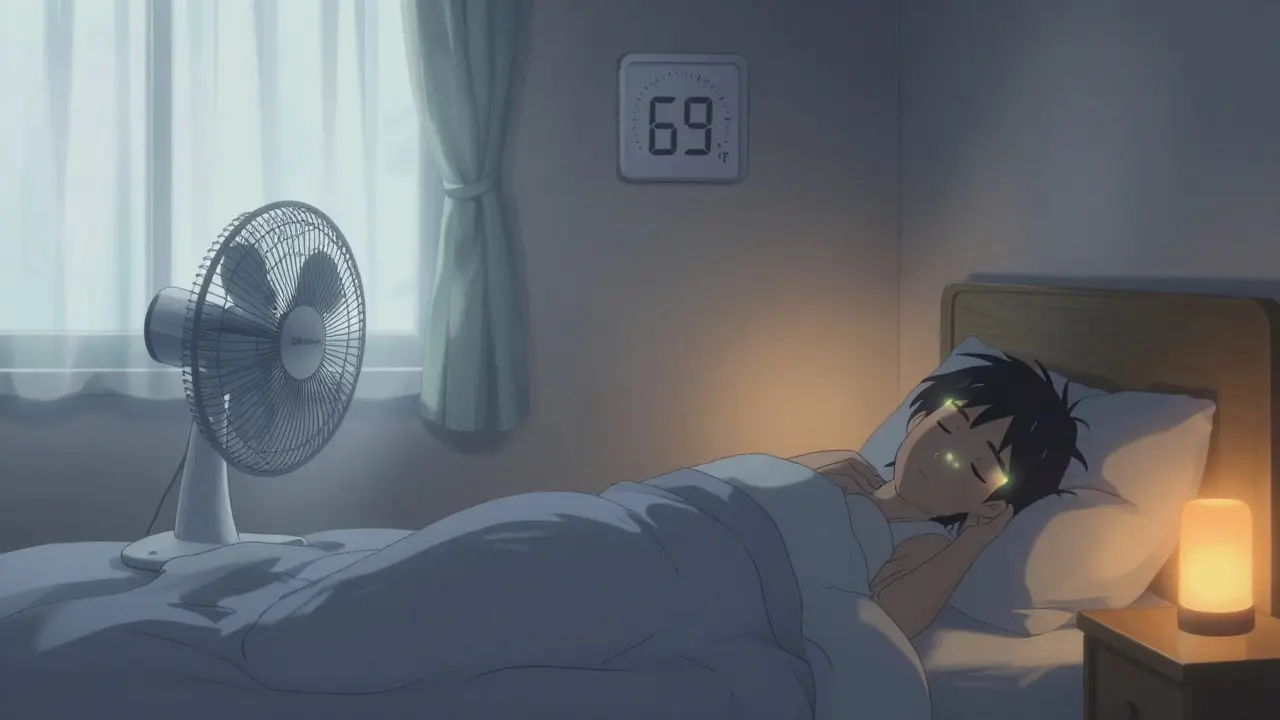
Temperature matters. Studies show the ideal sleep temperature is between 60-67°F (15.6-19.4°C). Too warm, and your body can’t drop its core temperature-something it needs to do to fall and stay asleep. Too cold? You’ll toss and turn trying to get warm.
Light is even more critical. Even small amounts of artificial light-like the glow from a charger or a digital clock-can suppress melatonin. Experts recommend keeping bedroom light under 5 lux at night. That’s dimmer than a nightlight. If you need a light, use red or amber. Blue and white light? Avoid it.
And silence? Not always necessary. But if noise wakes you, use earplugs or a fan. The goal isn’t perfect quiet-it’s predictable, non-disruptive background sound.
3. Wind Down Your Mind
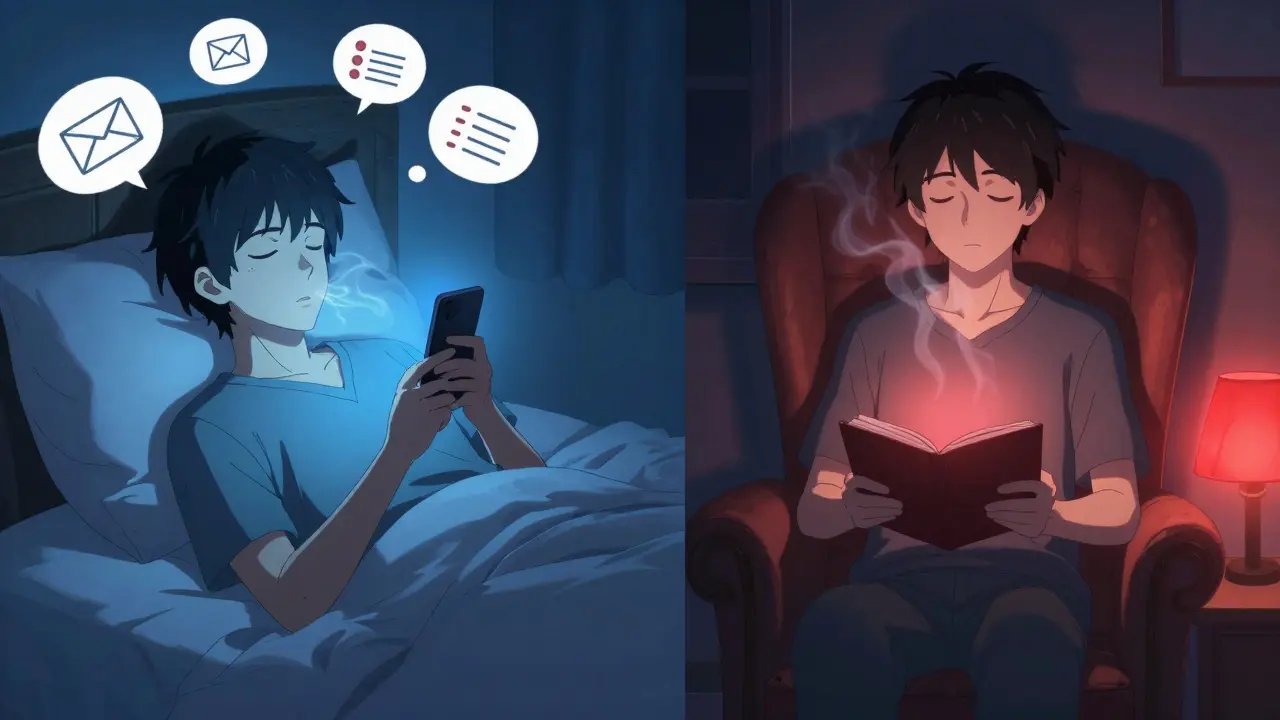
Most people think sleep starts when they lie down. But it starts hours before. If your brain is still running through work emails, arguments, or tomorrow’s to-do list, it won’t shut off.
A 2023 meta-analysis found that pre-sleep cognitive arousal-the mental chatter right before bed-was the strongest behavioral predictor of poor sleep. It had a bigger impact than caffeine or screen time.
Here’s what works: Build a 30-60 minute wind-down routine. Not a Netflix binge. Not scrolling Instagram. Something calm. Read a physical book. Do light stretching. Write down three things you’re grateful for. Or just sit quietly with your eyes closed. The goal isn’t to fall asleep. It’s to shift from “doing” mode to “being” mode.
One Reddit user, u/NightOwlPhD, said switching from scrolling to journaling cut his time to fall asleep from 90 minutes to 25 in just three weeks.
4. Fuel Your Body Right
What you eat and drink during the day affects your sleep more than you realize.
Caffeine: It lasts longer than you think. A 2021 study found that even consuming caffeine 6 hours before bed reduced total sleep time by over an hour. The rule? No caffeine after 2 p.m. If you’re sensitive, move it to noon.
Food: Heavy meals within 3 hours of bed can trigger digestion that keeps your body alert. A late pizza or curry might make you feel sleepy right after eating, but it’ll disrupt deep sleep later. Stick to light snacks if you’re hungry-banana, yogurt, or a handful of almonds.
Fluids: Drinking too much before bed means bathroom trips. And waking up to pee is one of the top reasons people can’t stay asleep. Limit fluids 1-2 hours before bed.
Exercise: Contrary to old advice, working out at night doesn’t ruin sleep for most people. A 2023 study from the University of Tsukuba found that 68% of participants slept better after evening workouts. Just avoid intense exercise right before bed. Aim to finish at least 90 minutes before sleep.
What Doesn’t Work (And Why)
Not all advice you hear is backed by science. Here are three myths that waste time-and sometimes make things worse.
Myth 1: Blue Light Blocking Glasses Are a Miracle Fix
Everyone talks about blue light from phones. But a 2024 meta-analysis by the Sleep Foundation reviewed 23 studies and found that blue light filters only reduce sleep onset latency by 4-7 minutes. That’s not nothing-but it’s not the main problem. The real issue? The mental stimulation of scrolling. Checking messages, watching videos, or replying to emails keeps your brain active. So yes, put the phone away. But not because of the light. Because of the content.
Myth 2: You Need to Avoid All Naps
Long naps after 3 p.m.? Yes, they ruin nighttime sleep. But a 20-minute power nap before 2 p.m.? It can actually improve alertness and memory. The problem isn’t napping-it’s timing and length. If you nap longer than 30 minutes or too late, you’re entering deep sleep and then waking up groggy. That confuses your sleep drive.
Myth 3: Going to Bed Hungry Helps
Some sleep guides say going to bed slightly hungry helps you sleep. But a 2023 study found this backfired for 22% of people. If you’re truly hungry, your body releases cortisol-the stress hormone-to find food. That’s the opposite of relaxation. Eat a light snack if needed. Don’t go to bed with an empty stomach if it makes you restless.
How Long Until You See Results?
Most people expect overnight changes. They’re disappointed when sleep doesn’t improve after three days. But sleep hygiene isn’t a quick fix. It’s a reset.
Studies show it takes 7-10 days to track your baseline sleep patterns. Then 14-21 days of consistent practice before you notice real change. A 2022 study of Canadian university students found that those who stuck with five or more sleep hygiene practices saw their sleep quality scores drop from “clinically poor” to “normal” in just three weeks.
Track it. Use a notebook or a free app like Sleep Cycle or ShutEye. Write down: when you went to bed, when you woke up, how you felt in the morning, and what you did before bed. You’ll start seeing patterns. Maybe you sleep better after reading instead of watching YouTube. Or maybe you wake up more rested when you skip afternoon coffee.
When Sleep Hygiene Isn’t Enough
Sleep hygiene is powerful-but it’s not a cure-all. If you’ve been doing all this for 6 weeks and still can’t sleep, or if you’re waking up gasping, snoring loudly, or feeling exhausted even after 8 hours, you might have a medical issue.
Chronic insomnia (sleeping poorly at least 3 nights a week for 3 months or more) often needs more than habits. Cognitive Behavioral Therapy for Insomnia (CBT-I) combines sleep hygiene with mental techniques to change how you think about sleep. It’s the gold standard treatment. And it works.
But here’s the thing: even CBT-I starts with sleep hygiene. It’s the foundation. You can’t build a house on sand. And you can’t fix sleep on a broken routine.
Real People, Real Changes
Take Sarah, 32, from Sydney. She worked in marketing, constantly checking emails until midnight. She’d wake up at 7 a.m. but feel like she hadn’t slept. She started by setting a 6:30 a.m. wake-up time-no matter what. She turned off her phone at 10:30 p.m. and read for 20 minutes. No screens. No work. Just quiet.
Within two weeks, she stopped waking up at 3 a.m. Within a month, she didn’t need her afternoon coffee. She told her boss she was more focused. Her manager noticed.
Or James, 27, a university student. He slept 5 hours a night, napped after class, and drank energy drinks. He started tracking his sleep. He saw that on days he napped past 2 p.m., he took 45 minutes to fall asleep. He cut naps. He stopped drinking soda after 3 p.m. He went to bed 30 minutes earlier. In three weeks, he went from 5 to 7.5 hours of sleep. His grades improved.
These aren’t lucky breaks. They’re results of changing behavior.
Your Next Step
You don’t need to overhaul your life. Pick one thing. Just one.
- Set your wake-up time and stick to it for 7 days.
- Turn off all screens 1 hour before bed.
- Stop caffeine after 2 p.m.
- Make your bedroom darker and cooler.
Do that one thing consistently. Then add another. Sleep hygiene isn’t about perfection. It’s about progress. Small changes, repeated over time, rewire your brain’s sleep response. And that’s how you get back the rest you’ve been missing.
Can sleep hygiene help with insomnia?
Yes-but only for mild cases. If you struggle to fall or stay asleep 3 or more nights a week for over a month, you likely have clinical insomnia. Sleep hygiene can help as a foundation, but it’s not enough on its own. The most effective treatment is Cognitive Behavioral Therapy for Insomnia (CBT-I), which includes sleep hygiene plus techniques to change anxious thoughts about sleep. The American Academy of Sleep Medicine recommends CBT-I as the first-line treatment for chronic insomnia.
How long does it take for sleep hygiene to work?
You won’t see results overnight. Most people notice small improvements after 7-10 days. Meaningful changes-like falling asleep faster or staying asleep longer-usually appear after 2-4 weeks of consistent practice. A 2022 study showed that people who followed 5+ sleep hygiene habits for 21 days saw their sleep quality scores drop from “poor” to “normal.” Patience is key. This isn’t a quick fix. It’s a long-term reset.
Is it okay to nap during the day?
A short nap-20 minutes or less-before 2 p.m. can help restore alertness without hurting nighttime sleep. But longer naps or naps after 3 p.m. interfere with your sleep drive. They make it harder to fall asleep at night and can leave you groggy. If you’re sleeping poorly at night, avoid naps entirely for a week. You’ll likely find your nighttime sleep improves.
Do I need to buy a sleep tracker or app?
No. While apps like Sleep Cycle or ShutEye can help you track patterns, they’re not required. The most important tool is awareness. Just write down in a notebook: when you went to bed, when you woke up, how you felt, and what you did before bed. That’s enough to spot trends. Sleep trackers can be helpful, but they can also create anxiety if you obsess over the numbers. Focus on how you feel, not the data.
Why is my wake-up time more important than my bedtime?
Your body’s internal clock is most strongly influenced by when you wake up-not when you go to bed. If you wake up at the same time every day, your brain learns to release sleep chemicals at a consistent time the night before. That makes falling asleep easier. If you sleep in on weekends, you’re resetting your clock backward, making Monday night harder. Consistent wake times anchor your circadian rhythm. Bedtime can vary by an hour or so, but wake time should be fixed.




Reviews
Oh honey, I tried all this 'sleep hygiene' nonsense and let me tell you - it’s just capitalism repackaging laziness as discipline. I set a wake-up time? Sure. Then my cat jumped on my face at 5:30 a.m. and now I’m traumatized. Also, who decided 67°F is ideal? I’m from Canada. We sleep under six blankets and still shiver. This isn’t science - it’s a cult with a spreadsheet.
Wait - so you’re telling me I can’t nap after lunch and still be a good person? Bro, I’m a college student. I nap because my 8 a.m. class is a crime against humanity. Also, who says 2 p.m. is the cutoff? I had coffee at 3:30 p.m. and slept like a baby. Coincidence? I think not.
Love this breakdown!! 🙌 Seriously, the part about the bedroom being a cave? YES. I turned my room into a dark, silent, 65°F tomb and now I’m basically a sleep god. 🌙💤 Also, no caffeine after 2? Game changer. I used to think I was a ‘coffee zombie’ - now I’m just a chill human with a soul. Thanks for the clarity!!
You know what’s wild? People treat sleep like a reward you earn by being productive. Nah. Sleep is your birthright. You don’t need to ‘optimize’ it - you need to stop sabotaging it. I used to think I had to ‘earn’ rest. Then I stopped trying to earn it. Started sleeping. Life changed. Not because I did everything right - but because I stopped punishing myself for being human.
This is so well-researched and kind. Thank you. 🌿 I used to feel guilty for needing sleep. Like it was a weakness. But learning that consistency > perfection changed everything. I wake up at 6:45 every day. Even on holidays. Even when I’m sad. Even when I’m mad. My body knows now. And that’s peace.
Woke up at 6:30. Didn't check phone. Read a page. Slept well. Simple. No app needed. 🌙
Let’s be real - if you’re still scrolling TikTok at midnight, you’re not ‘sleeping poorly,’ you’re spiritually bankrupt. Your brain is a landfill of dopamine junk. No amount of 67°F bedrooms will fix that. You need a digital detox, not a sleep schedule. And if you think melatonin is the answer? Honey, you’re not broken - you’re addicted. Go live in the woods for a week. Then come back.
Consistency is key. I followed the wake-up time rule for seven days. I felt better. Not magically. Not instantly. But steadily. I stopped blaming my insomnia. I started respecting my rhythm. That’s all it took.
Wait, so if I nap after 2 p.m., I’m basically poisoning my sleep? What if I’m a shift worker? Or a single parent? Or just exhausted from trauma? This advice is for rich people with 9-to-5s. I work nights. I nap when I can. You telling me I’m doing it wrong? I’m surviving. And I’m still tired. So thanks for the judgment, but I’ll nap when I need to.
You got this. One step. Just one. Pick the wake-up time. Set the alarm. Do it for a week. You don’t have to change everything. Just one thing. Then you’ll see - your body remembers how to rest. And you’ll thank yourself. I did. 💪🌙
Interesting how we treat sleep like a problem to be solved, when really it’s a signal. If you’re struggling, your body isn’t broken - it’s trying to tell you something. Maybe you’re overworked. Maybe you’re lonely. Maybe you’re afraid. Sleep hygiene helps, sure - but it’s not the root. Ask yourself: what am I avoiding when I stay up late? That’s the real question.
There’s a quiet revolution happening - not in labs, not in clinics - but in bedrooms, at 2 a.m., when the world is still and your thoughts scream louder than ever. Sleep hygiene isn’t about fixing sleep. It’s about reclaiming the sacred silence between breaths. The moment you stop fighting your body… that’s when rest finds you. I cried the first night I didn’t check my phone. I didn’t know I was so afraid of stillness. Now? I sleep like I’m held. 🌌
Wake-up time? Caffeine cutoff? You think this is about sleep? No. This is a psyop. The government wants us tired. Tired people don’t protest. Tired people don’t think. Tired people just scroll. They gave us this ‘sleep hygiene’ guide to make us feel guilty for not sleeping - while they watch us from satellites. You think 5 lux is real? That’s the number they use to calibrate surveillance lights. Don’t fall for it. Sleep with the lights on. Stay alert. Question everything.