
Palliative Care Symptom Management Calculator
Symptom Management Assessment Tool
This tool helps evaluate whether symptom management approaches might be causing harmful side effects. Based on evidence from NHS guidelines and clinical studies.
Risk Assessment Results
When someone is living with a serious illness, the goal isn’t always to cure it. Sometimes, the most important thing is to make sure they’re as comfortable as possible. That’s where palliative care comes in. It’s not about giving up. It’s about focusing on quality of life-reducing pain, shortness of breath, nausea, anxiety, and other distressing symptoms-while being careful not to cause new problems. Hospice care is a type of palliative care for people with six months or less to live who have chosen to stop curative treatments. Both aim for comfort, but getting that balance right is harder than it sounds.
It’s Not Just About Medication
Many people assume palliative care means turning up the morphine until the pain goes away. But that’s not how it works. Too much pain medicine can cause drowsiness, confusion, constipation, or even trouble breathing. And if you’re already weak from illness, those side effects can make things worse. The key is precision. Not more drugs, but the right drug, at the right dose, at the right time. In the NHS North West guidelines, doctors are trained to assess pain using a detailed checklist: location, type (sharp, dull, burning), what makes it better or worse, and how it affects daily life. Patients often have more than one kind of pain at once-bone pain from cancer, nerve pain from chemotherapy, muscle pain from lying in bed too long. Treating them all the same way leads to overmedication. That’s why using a 0-to-10 pain scale isn’t enough. You need to know what kind of pain you’re dealing with before you choose the treatment.Managing the Most Common Symptoms
Pain, shortness of breath, nausea, and anxiety are the big four. Each has proven approaches, but they’re not one-size-fits-all. For pain, opioids like morphine or oxycodone are the first-line treatment. But they’re not the only tool. Nerve pain responds better to gabapentin or duloxetine. Bone pain often needs bisphosphonates. The Dana-Farber Cancer Institute breaks these into separate guides-their "Pink Book" for pain, "Green Book" for nausea-because mixing them up leads to mistakes. Shortness of breath is often treated with low-dose opioids, even if the patient isn’t in pain. Evidence shows they help the feeling of air hunger. But you can’t just give a high dose. A 2017 review by the American Academy of Family Physicians rated opioids as "B" evidence for dyspnea-meaning they work, but only when carefully titrated. Oxygen isn’t always helpful unless the patient is truly low on oxygen. Often, a fan blowing gently on the face or sitting upright does more than a nasal cannula. Nausea and vomiting need different drugs depending on the cause. Is it from bowel obstruction? Then corticosteroids like dexamethasone are preferred. Is it from chemotherapy? Then ondansetron or metoclopramide work better. Octreotide, sometimes used for bowel issues, has limited benefit and can cause high blood sugar or diarrhea. Using the wrong drug can make things worse. Anxiety and agitation are often treated with lorazepam, but only if the patient is truly anxious-not confused or in pain. Delirium looks like anxiety but needs different handling. The UPenn Comfort Care Guidelines recommend checking for delirium every 12 hours using the CAM-ICU tool. If it’s there, haloperidol is the go-to, but only up to 10 mg IV. Higher doses can cause dangerous heart rhythms. And once the patient is calm, you stop the meds. Long-term use isn’t safe.The Hidden Problem: Overmedication
One of the biggest risks in palliative care isn’t under-treating symptoms-it’s over-treating them. A 2022 Fraser Health survey found that 68% of nurses didn’t have enough time to complete full symptom assessments. So they defaulted to giving more meds. That’s how patients end up drowsy, confused, or unable to talk to their families. At UPenn, they solved this by requiring documentation after every dose. If a nurse gives lorazepam, they must write down: the patient’s level of agitation before, the dose given, the time, and how the patient responded 30 minutes later. That simple habit cut breakthrough symptoms by 52% and reduced unnecessary sedation. Another problem? Families. They often fear their loved one will be "drugged up" and ask for less medicine. But when they see the difference-when Dad can smile again, or Mom can hold their hand without crying from pain-they change their minds. That’s why communication matters as much as medication. The National Coalition for Hospice and Palliative Care says families have a "right to live and die free of pain, with dignity." That’s not a slogan. It’s a promise.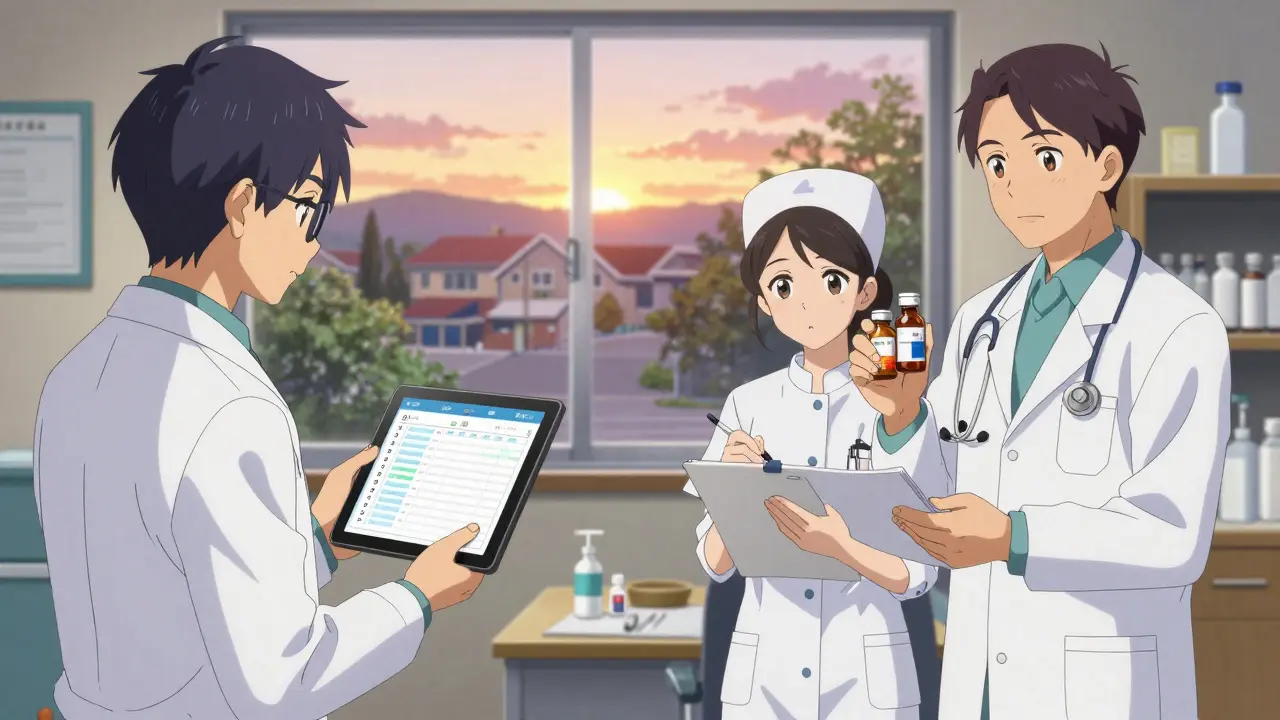
Non-Drug Tools Matter Just as Much
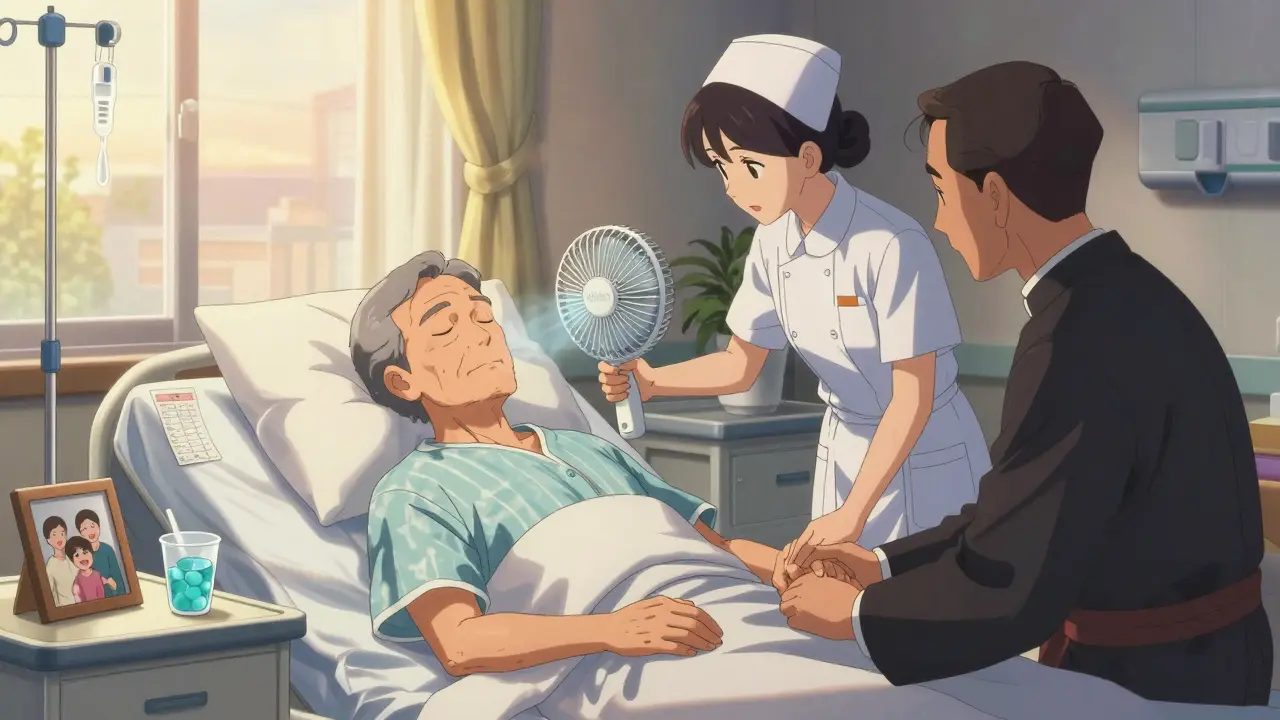
Medicines aren’t the only way to help. In fact, the best palliative care teams use them as a last resort after trying simpler things. For pain: heat packs, gentle massage, repositioning, distraction with music or photos. For shortness of breath: positioning the patient upright, using a handheld fan, practicing slow breathing. For anxiety: having a chaplain sit quietly with the patient, playing familiar songs, letting a pet visit. For constipation: fiber, fluids, stool softeners-not just laxatives. The NIH’s 2023 strategic plan allocated $47 million to study non-drug approaches because they work-and they don’t come with side effects. A 2023 Fraser Health update found that adding cannabinoid therapy reduced opioid use by 37% in some patients. Not because it cured pain, but because it helped them relax enough to need less morphine.Why Timing Is Everything
Pain is easier to prevent than to fix. That’s why proactive care beats reactive care. Waiting until someone is screaming before giving pain meds is a mistake. Giving scheduled doses-like every 4 hours-even if the patient says they’re fine, prevents spikes. It’s like filling a glass before it’s empty. In hospice, teams use "comfort care order sets"-pre-made checklists that guide nurses on what to check, what to give, and when. One 2008 study showed that using these order sets increased nurse confidence in managing symptoms by 37%. That’s huge. When nurses feel prepared, patients get better care. The same applies to bowel issues. If a patient is at risk for obstruction, start laxatives early. Don’t wait for bloating. If someone has dry mouth from medications, offer ice chips or lip balm before they ask. These small actions add up.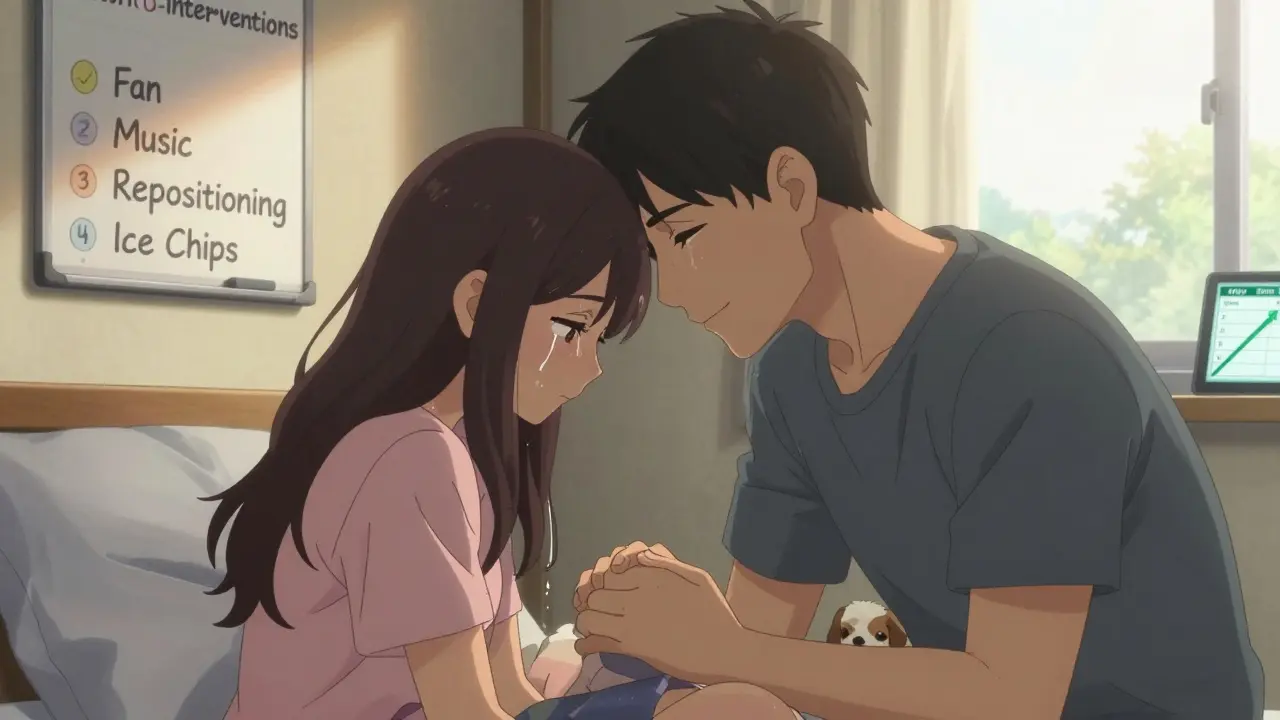
Who’s Really in Charge?
Palliative care isn’t a single doctor’s job. It’s a team. A doctor, a nurse, a social worker, a chaplain, and sometimes a pharmacist. Each brings something different. The doctor prescribes. The nurse monitors. The social worker helps with finances or housing. The chaplain talks about meaning, fear, or regret. And the patient? They’re the boss. No one decides what comfort looks like except them. One person wants to stay alert to watch their grandchild’s graduation. Another wants to sleep through the last days. Neither is right or wrong. The job of the care team is to honor that.What’s Changing Now?
The field is evolving fast. Digital tools are being tested-apps where patients rate their pain daily on their phone. Early results show 18% better symptom control because problems are caught earlier. Tele-palliative care is expanding, especially in rural areas where 55% of counties have no specialist. By 2027, 40% of rural patients may get care via video call. The next version of the National Coalition’s guidelines, due in 2025, will focus on integrating these tools. Also, researchers are looking at genetics. A 2022 JAMA study found that certain gene variants predict how someone will respond to opioids. That could mean personalized dosing in the future-no more guessing. But the biggest challenge remains: not enough people. There are only 7,000 certified palliative care doctors in the U.S., but over 22,000 are needed. Most general practitioners don’t know how to adjust morphine for kidney failure, even though 87% of palliative specialists say that’s a common gap.What You Can Do
If you or someone you love is entering palliative or hospice care:- Ask: "What symptoms are we trying to manage today?" Not just "Is the pain gone?"
- Request a full assessment-not just a pain score, but a description of the pain type.
- Ask about non-drug options before accepting more pills.
- Insist on documentation: "Can you write down what we gave and how they responded?"
- Speak up if your loved one seems too sleepy, confused, or unresponsive. It might be too much medicine.
- Remember: comfort isn’t the absence of all symptoms. It’s having control over them.
Palliative care isn’t about dying. It’s about living-right up until the end-with dignity, peace, and as little suffering as possible. Getting there takes time, skill, and courage. But it’s possible. And it’s worth it.

Reviews
I’ve seen this firsthand with my grandma. They gave her too much morphine at first and she couldn’t even hold my hand. Then they adjusted it - just enough to take the edge off without knocking her out. That’s when she smiled for the first time in weeks. It’s not about making pain disappear. It’s about making moments possible.
Let’s not romanticize this. Palliative care is a logistical nightmare in the U.S. because insurance doesn’t cover non-pharmacological interventions unless they’re bundled under hospice - and even then, only if the patient is ‘imminently dying.’ The NIH’s $47 million for non-drug research? Cute. Meanwhile, hospitals still use outdated pain scales and nurses are stretched so thin they’re giving lorazepam on autopilot. The real problem isn’t overmedication - it’s under-resourcing. We’re treating symptoms like they’re checkboxes on a form, not human experiences. Until we fund teams properly, none of these guidelines matter.
In my village in Nigeria, we don’t have morphine - but we have hands. Grandmothers rub warm shea butter on swollen joints. Children hum ancestral songs while holding trembling hands. We don’t measure pain on a scale of 1 to 10 - we measure it in silence, in the way a body leans into comfort. The West thinks precision means more drugs. But sometimes, precision means presence. The most powerful medicine is not in a vial - it’s in a voice that says, ‘I’m still here.’
Wait - so you’re telling me the NHS and Dana-Farber are just now figuring out that giving people too much opioids causes confusion? And that families are being manipulated into accepting sedation as ‘comfort’? This isn’t medicine - it’s institutionalized euthanasia disguised as compassion. The pharmaceutical lobby pushed opioids for decades, and now they’re pushing ‘palliative protocols’ to quietly remove inconvenient elderly patients. They don’t want you to know that a fan and ice chips can be more effective than 10mg of lorazepam. They want you dependent. And the ‘documentation’ they brag about? That’s just to cover their tracks when someone dies from iatrogenic sedation.
My uncle was in hospice. They started him on gabapentin for nerve pain, then added a low-dose morphine patch. But they also had a volunteer come in every afternoon to play jazz records. He’d tap his fingers. That’s the secret - it’s not just what you give. It’s what you allow. The music didn’t cure anything. But it made him feel alive again. Sometimes, the best treatment is permission - permission to be quiet, to be scared, to be human.
One thing I wish more people understood: palliative care isn’t about giving up. It’s about choosing what matters. My mom didn’t want to be awake to watch TV. She wanted to hear her dog breathe beside her. So we stopped the nighttime meds that made her groggy. We let her sleep - but we kept the dog there. That’s dignity. It’s not about the drugs. It’s about the quiet, messy, beautiful details that make someone feel like themselves.
Let’s be real - this whole palliative care model is just Big Pharma’s way of monetizing death. Opioids? Patentable. Fans? Not patentable. Music therapy? Can’t be trademarked. That’s why the guidelines are saturated with pharmacological protocols and zero mention of, say, acupuncture or Reiki - even though studies show they reduce opioid use. The ‘Pink Book’ and ‘Green Book’? Those are marketing tools. The real agenda? Keep people on prescriptions until the end - and bill insurance for every pill. The ‘non-drug’ stuff is lip service. They know it works. They just don’t profit from it.
Why do we need so many doctors? In India, we take care of our own. The family sits with the sick. We give warm milk with turmeric. We sing prayers. We hold hands. Why do you need a checklist? Why do you need a nurse to write down every dose? Because you have forgotten how to love. You outsource death to professionals. But death is not a hospital job. It is a family duty.
It is with profound sorrow - and a heavy heart - that I must address the chilling commodification of human vulnerability currently masquerading as medical ethics. The very notion that comfort can be quantified via a 0-to-10 scale is not merely reductionist - it is an affront to the sanctity of suffering. We have replaced the sacred silence of the dying with algorithmic protocols, replacing the whisper of a loved one’s voice with the sterile hum of IV pumps. The ‘comfort care order sets’ you so proudly cite? They are not guidelines - they are bureaucratic shrouds, draping the corpse of compassion in the garb of efficiency. This is not healing. This is industrialized dying.
Okay but have you seen the JAMA study on CYP2D6 polymorphisms and opioid metabolism? 😳 Like, if someone is a poor metabolizer, giving them standard morphine doses is basically a death sentence. And yet 87% of GPs don’t even know what CYP2D6 is. 🤯 We’re flying blind with pain meds. And don’t get me started on how hospice programs get reimbursed - it’s all based on days of service, not outcomes. So they keep people on meds just to hit the 72-hour mark for billing. 💀 This system is rigged. And the ‘non-drug’ stuff? That’s just PR for donors. Real change requires genetic testing. And funding. And accountability. Not fans. 🙄
I work in a hospice unit. I’ve watched families go from terrified to tearful to thankful - all because someone took the time to explain what ‘comfort’ really means. One woman asked, ‘Will he still know it’s me?’ I said, ‘Yes - if you hold his hand, he’ll feel you. Even if he doesn’t respond.’ That’s the magic. Not the meds. The presence. The quiet. The ‘I’m here.’ That’s what we’re really giving.
Did you know the FDA approved morphine for palliative use in 1988 without any long-term safety data? And now they’re pushing ‘low-dose opioids for dyspnea’ like it’s gospel? But the same agency approved Vioxx for arthritis and killed thousands. Coincidence? No. The same lobbyists. The same labs. The same ‘evidence’ funded by pharma. They’re testing opioids on dying people because they can’t test them on healthy ones. And we’re calling it ‘care.’ It’s medical exploitation. And they’re hiding it behind ‘dignity’ and ‘comfort.’
They say ‘palliative care is about quality of life’ - but who defines quality? The hospital? The insurance company? The nurse with 30 seconds to document? Or the person actually dying? I’ve seen people sedated because they were ‘too emotional’ - crying, asking for their dead husband, wanting to talk about regrets. That’s not ‘agitation.’ That’s being human. And they’re drugging it away. They don’t want us to remember that death is messy. That grief is loud. That love doesn’t end with a clean dose. They want it quiet. Clean. Controlled. And that’s not comfort. That’s erasure.