To get started, we need to define what we are actually talking about. Dietary fiber is a non-digestible carbohydrate found only in plant foods that the human body cannot break down on its own. Unlike other nutrients, fiber doesn't get absorbed in the small intestine. Instead, it travels to the large intestine, where it either bulks up your stool or feeds the trillions of bacteria living in your gut. Depending on whether it dissolves in water, it falls into one of two categories: soluble or insoluble.
The Gel-Maker: Understanding Soluble Fiber
Think of Soluble fiber as a sponge. When it hits water in your digestive tract, it turns into a thick, gel-like substance. This gel is a powerhouse for your metabolic health. Because it slows down the speed at which food moves through your gut, your body has more time to absorb nutrients and sugar. This is why it's a game-changer for blood sugar levels; clinical data shows it can reduce post-meal glucose spikes by up to 30%.
But the real magic happens in the colon. Your gut bacteria ferment this fiber, turning it into Short-Chain Fatty Acids (or SCFAs), such as butyrate. These SCFAs aren't just waste products; they fuel the lining of your gut and send signals to your brain that tell you you're full. This is the core of the gut-brain axis, where the health of your microbiome directly impacts your mood and appetite.
If you want to increase your soluble intake, look for these foods:
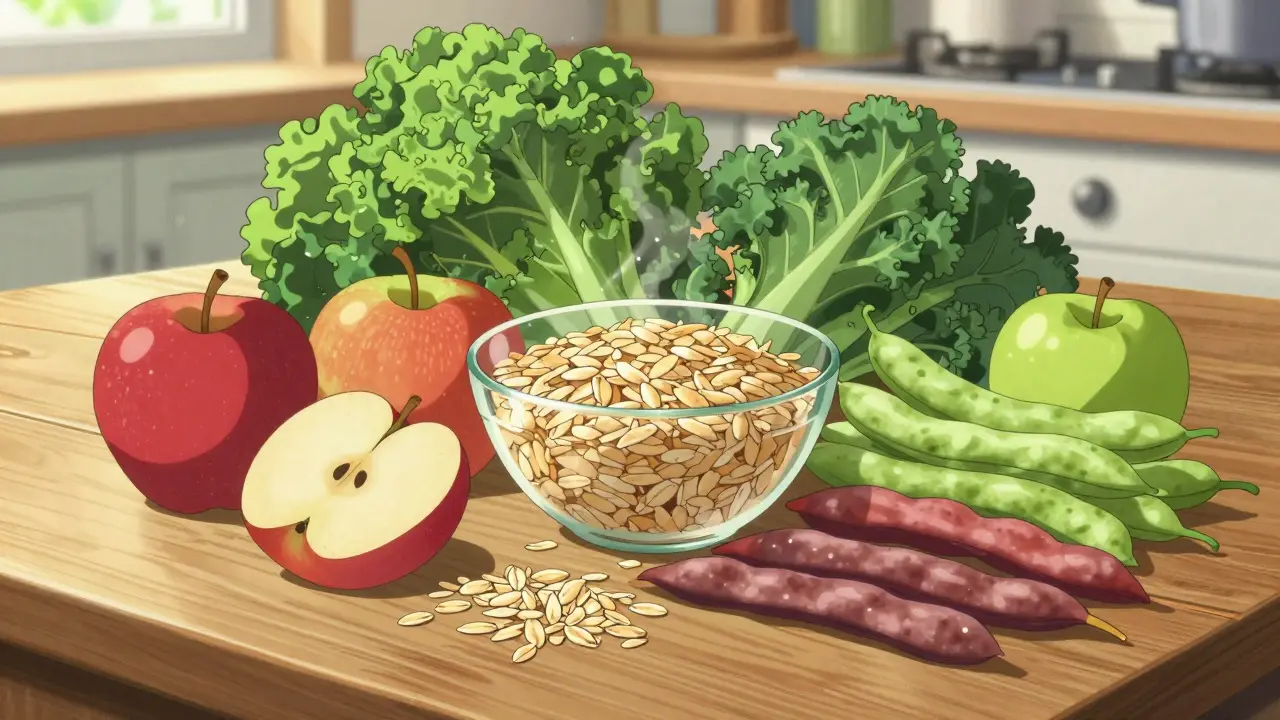
- Oats: A classic choice, providing about 1-2 grams per 100g.
- Beans and Lentils: Legumes are soluble fiber goldmines, with beans offering 5-8 grams per 100g.
- Chia Seeds: A small 30g serving gives you about 5.6 grams of the gel-forming kind.
- Fruits: Apples and carrots are great, though you get a mix of both types here.
The Broom: The Role of Insoluble Fiber
While soluble fiber is like a sponge, Insoluble fiber is more like a broom. It doesn't dissolve in water and stays mostly intact as it moves through you. Its primary job is to add bulk to your stool and push things along. If you struggle with chronic constipation, this is your best friend. It can increase stool bulk by 30-50%, which effectively "sweeps" the digestive tract and speeds up transit time.
This type of fiber consists mostly of cellulose and lignin-the tough parts of plant cell walls. While it doesn't feed gut bacteria as much as soluble fiber does, it's essential for preventing diverticular disease, which is when small pouches form in the colon wall. Long-term studies suggest a high-insoluble diet can cut the risk of this condition by 40%.
You can find high amounts of the "broom" fiber in:
- Wheat Bran: One of the most concentrated sources, with 12 grams per 100g.
- Whole-Wheat Flour: Provides about 7.9 grams per 100g.
- Nuts and Seeds: Great for snacking, offering 2-4 grams per serving.
- Vegetable Skins: Don't peel your carrots or kiwis; the skin is where the insoluble fiber lives.

Comparing the Two: Which One Do You Need?
You shouldn't be choosing one over the other; you need both. However, depending on your current symptoms, you might want to lean more heavily on one type. For example, people with Irritable Bowel Syndrome (IBS) often find that soluble fiber (like psyllium husk) helps stabilize both diarrhea and constipation. On the flip side, if you are experiencing a flare-up of Inflammatory Bowel Disease (IBD), too much insoluble fiber can actually irritate the gut lining and make things worse.
| Feature | Soluble Fiber | Insoluble Fiber |
|---|---|---|
| Action | Forms a gel, slows digestion | Adds bulk, speeds up transit |
| Primary Benefit | Lowers LDL cholesterol & blood sugar | Prevents constipation & diverticulosis |
| Gut Impact | Fermented into SCFAs (feeds bacteria) | Mechanical cleaning of the colon |
| Best For | Metabolic health, IBS stability | Regularity, "cleaning out" the system |

The Gold Standard: The Mediterranean Approach
If you're wondering how to balance these two, don't bother with expensive supplements. Most experts agree that isolated fiber supplements can't replicate the complex matrix of whole foods. Instead, look at the Mediterranean Diet. This eating pattern is widely considered the best anti-inflammatory approach because it naturally hits a 3:1 ratio of insoluble to soluble fiber.
By focusing on whole grains, legumes, fruits, and nuts, you get a synergistic effect. The vitamins and phytonutrients in these foods work with the fiber to reduce inflammation and improve heart health. For instance, increasing soluble fiber by just 10 grams a day can lower your cardiovascular risk by 15%.
How to Increase Your Intake Without the Bloat
Here is the mistake most people make: they decide to get healthy, eat a massive bowl of beans and bran on Monday, and by Tuesday, they feel like a balloon. Your gut bacteria need time to adjust to the new workload. If you dump a ton of fiber into your system overnight, you'll likely experience severe bloating and gas.
The safe way to do this is the "5-gram rule." Increase your total fiber intake by no more than 5 grams per week. If you're starting at 15 grams, aim for 20 grams next week, then 25 the following. This gradual ramp-up gives your microbiome time to multiply the bacteria that digest these fibers.
Crucially, you must drink more water. Fiber needs water to work. Insoluble fiber absorbs liquid to bulk up stool; if you don't drink enough, that fiber can actually cause a blockage, making constipation worse. A good rule of thumb is to drink at least 1.5 to 2 liters of water for every 25 grams of fiber you consume.
Can I take fiber supplements instead of eating vegetables?
While supplements like psyllium husk are helpful for specific medical needs or those who truly cannot get enough from food, they aren't a perfect replacement. Whole foods provide a complex matrix of nutrients and antioxidants that supplements lack. Supplements provide the fiber, but whole foods provide the fiber plus the vitamins and minerals that help your body process it.
What is the recommended daily amount of fiber?
General guidelines suggest women should aim for about 25 grams per day and men around 38 grams, depending on age and gender. However, the most important factor is how your specific body reacts. Some people feel best at 30 grams, while others might struggle with more than 20 grams during certain health phases.
Why does soluble fiber help with cholesterol?
Soluble fiber binds to bile acids in your gut. Since bile acids are made from cholesterol, when the fiber binds to them and carries them out of the body as waste, your liver has to pull LDL (bad) cholesterol from your blood to make more bile. This effectively lowers the amount of cholesterol circulating in your bloodstream by 5-10%.
Is fiber safe during an IBD flare-up?
During an active Inflammatory Bowel Disease (IBD) flare-up, high amounts of insoluble fiber (like raw kale or wheat bran) can be too abrasive for the inflamed lining of the gut. Most guidelines suggest limiting insoluble fiber to 10-15 grams during a flare and focusing more on cooked vegetables or soluble sources until the inflammation settles.
How does fiber affect mental health?
The connection is through the gut-brain axis. When soluble fiber is fermented by gut bacteria, it produces SCFAs that stimulate the secretion of hormones like GLP-1. These hormones don't just control hunger; they communicate with the brain. Emerging research suggests that a diverse microbiome, fueled by various fibers, can improve mood and cognitive function.