
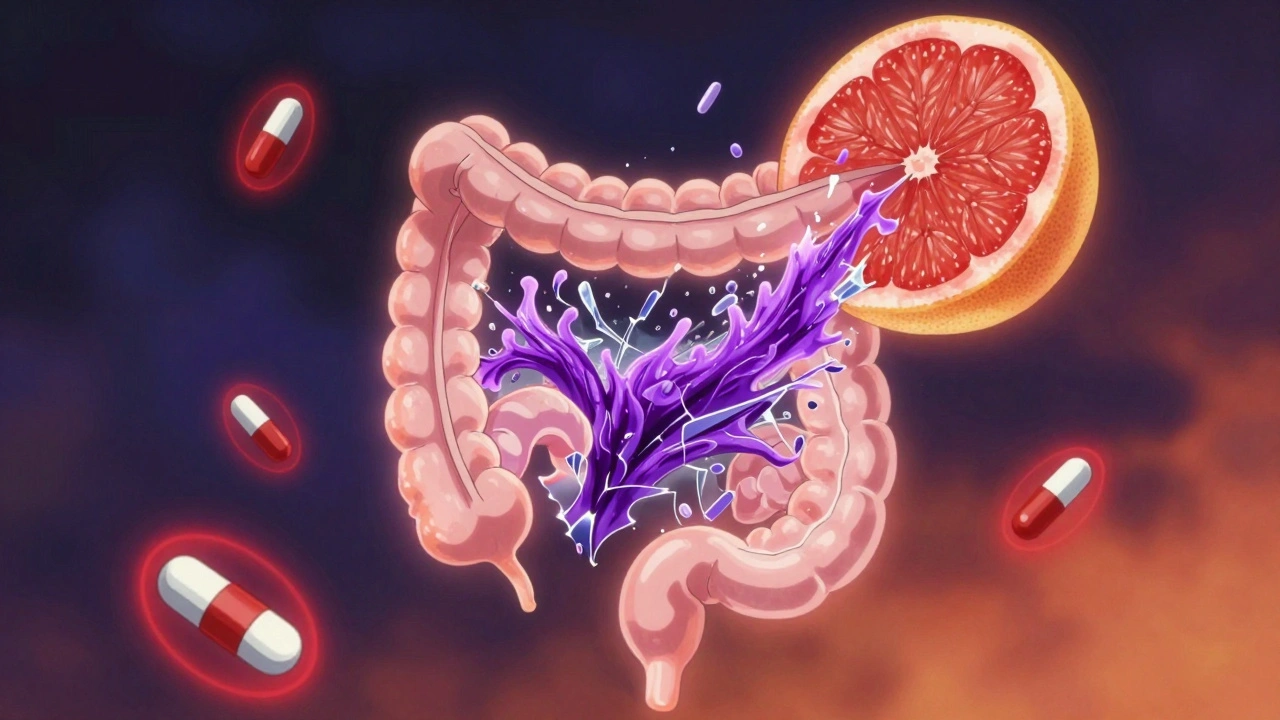
Most people know grapefruit is healthy-packed with vitamin C, antioxidants, and fiber. But if you’re on warfarin or an SSRI, that morning glass of juice could be riskier than you think. The problem isn’t the fruit itself. It’s what happens inside your body when grapefruit meets certain medications. This isn’t theoretical. It’s happening right now to people who don’t realize they’re playing Russian roulette with their blood thinners or antidepressants.
Why Grapefruit Breaks the Rules
Grapefruit doesn’t just interfere with medications-it breaks them. The culprit? Furanocoumarins, mainly bergamottin and DHB. These compounds don’t just slow down drug metabolism. They permanently disable a key enzyme system called CYP450, specifically the CYP3A4 enzyme in your gut. Once it’s shut down, your body can’t break down the drug properly. That means more of it gets into your bloodstream than intended.Unlike other interactions where timing matters-like taking a pill with food-grapefruit’s effect lasts for days. One 8-ounce glass can knock out 47% of your intestinal CYP3A4 for up to 72 hours. Even if you take your medication at night and drink grapefruit juice in the morning, you’re still at risk. Your body doesn’t have time to rebuild the enzyme. The damage is done until your gut cells make new ones.
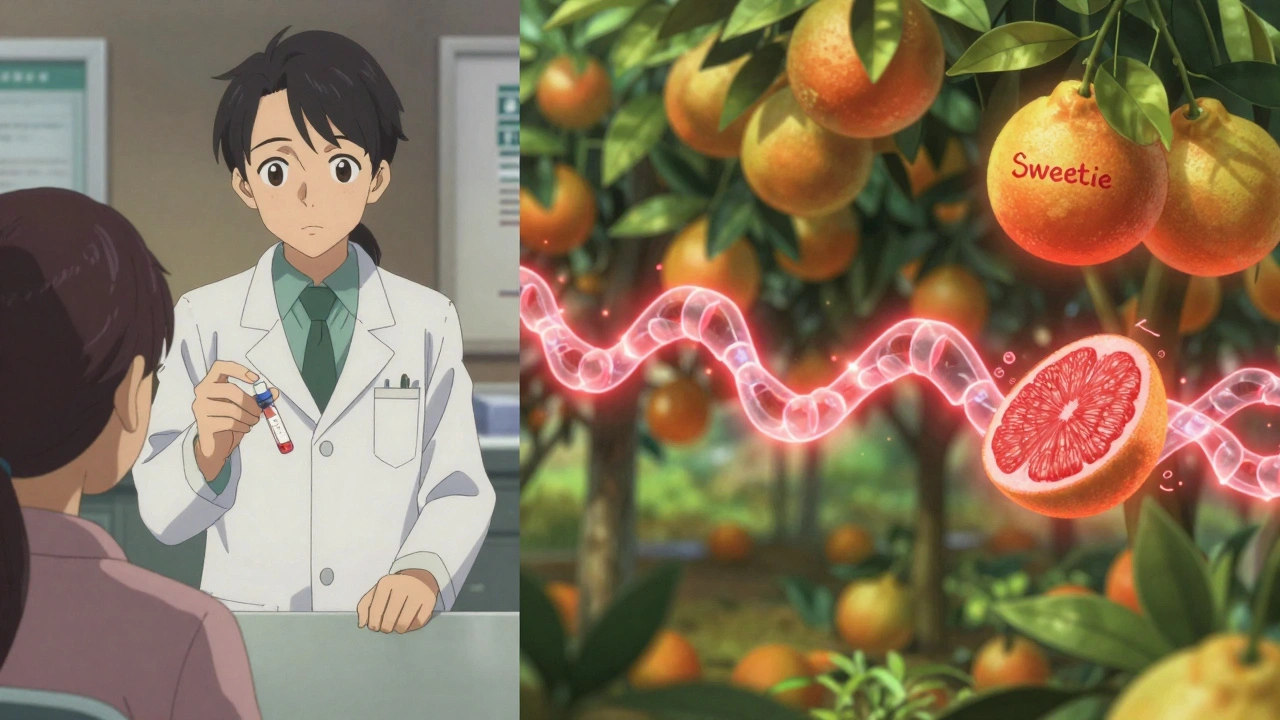
This isn’t just about grapefruit juice. Whole grapefruit, pomelos, and even some hybrid citrus like ‘Oroblanco’ and ‘Sweetie’ can be worse. A 2023 FDA warning flagged these varieties for having up to three times more furanocoumarins than traditional grapefruit. So if you’re avoiding grapefruit, don’t assume other citrus are safe.
Warfarin and the Thin Line Between Safe and Dangerous
Warfarin is a blood thinner with a razor-thin safety margin. Too little, and you risk clots. Too much, and you bleed internally. It’s metabolized mostly by CYP2C9 (80-90%), with a smaller portion handled by CYP3A4. Grapefruit doesn’t strongly inhibit CYP2C9, but it does-enough to matter in some people.Studies show inconsistent results. Some patients see no change in INR after drinking grapefruit juice. Others see spikes of 15-25%. Why the difference? Genetics. People with CYP2C9*2 or *3 variants metabolize warfarin slower to begin with. Add grapefruit’s weak inhibition of CYP2C9 and CYP3A4, and their blood levels can climb dangerously fast. A 2024 update to the PharmGKB database classified this interaction as ‘moderate’ (Level 2B), meaning it’s not common-but when it happens, it’s serious.
Real-world data backs this up. In a Drugs.com survey of over 1,200 warfarin users, 8.7% specifically avoided grapefruit. On Reddit’s r/pharmacy, 32% of users who mentioned grapefruit reported INR fluctuations after accidental consumption. That’s not a small number. For someone on warfarin, a single spike in INR can mean hospitalization. The Clinical Pharmacogenetics Implementation Consortium (CPIC) recommends avoiding grapefruit entirely if you have known CYP2C9 polymorphisms. Genetic testing for these variants costs $250-$400 and can clarify your personal risk.
SSRIs: Not All Are Created Equal
SSRIs are a mixed bag when it comes to grapefruit. Some barely interact. Others? Not so much.Fluoxetine and paroxetine are mainly broken down by CYP2D6. Grapefruit has minimal effect on this enzyme. So if you’re on one of these, grapefruit isn’t a major concern. Sertraline, however, is metabolized by CYP2C9, CYP2C19, and CYP3A4. That last one-CYP3A4-is the one grapefruit kills. A 2015 case series found sertraline blood levels jumped 27-39% in people who drank grapefruit juice daily. That’s enough to cause nausea, dizziness, or serotonin syndrome in vulnerable patients.
Citalopram and escitalopram are processed by CYP2C19 and CYP3A4. A March 2024 study in Clinical Pharmacology & Therapeutics tested escitalopram with grapefruit juice in 24 healthy volunteers. No significant change in drug levels. That’s good news-but it doesn’t mean you’re safe. The study was small, short-term, and didn’t include older adults or those with liver issues. Citalopram’s bioavailability is 80%, meaning it’s already well absorbed. Add grapefruit, and you’re pushing into risky territory.
Here’s the catch: many patients don’t know which SSRI they’re on. Doctors often prescribe by brand name. A patient might think “I’m on an antidepressant,” not “I’m on sertraline.” And if they’re drinking grapefruit juice daily for ‘heart health,’ they’re not connecting the dots. A 2022 survey of medical students found 64% wrongly believed all SSRIs interact with grapefruit. That confusion leads to either unnecessary fear or dangerous neglect.
Who’s at Real Risk?
Not everyone needs to ditch grapefruit. But some people absolutely do.- Warfarin users with CYP2C9 variants: Avoid grapefruit. Period. Genetic testing is worth it if you’ve had unexplained INR swings.
- People on sertraline: If you drink grapefruit juice daily, talk to your pharmacist. Switching to another SSRI might be safer.
- Older adults on multiple meds: As we age, liver function slows. Grapefruit’s effect is stronger. If you’re on warfarin, sertraline, or any other CYP3A4 substrate, skip it.
- People with liver disease: Your body already struggles to clear drugs. Grapefruit makes it worse.
On the flip side, if you take fluoxetine, citalopram occasionally, or are on a low dose of sertraline and only sip grapefruit juice once a week? The risk is low. But don’t assume it’s zero. The safest choice? Avoid it entirely.
What Should You Do?
Here’s the practical roadmap:- Know your meds. Look up your medication’s metabolism on Drugs.com or the FDA’s database. If it says ‘CYP3A4 substrate,’ grapefruit is a red flag.
- Check your SSRI. If it’s sertraline or citalopram, be cautious. Fluoxetine and escitalopram? Lower risk.
- Ask about genetic testing. If you’re on warfarin and have had unexplained bleeding or clotting, ask your doctor about CYP2C9 testing.
- Don’t rely on timing. Drinking grapefruit juice at night won’t save you if you take your pill in the morning. The enzyme stays down for days.
- Don’t assume other citrus are safe. Pomelos and ‘Sweetie’ may be worse than grapefruit.
Pharmacists at Mayo Clinic spend an average of 3.2 minutes per patient counseling on grapefruit interactions. Most of that time is spent on warfarin. But SSRIs are rising fast. With 4.7 million Americans on SSRIs and grapefruit consumption up 17% since 2019, the risk is growing. The FDA’s 2024 draft guidance will soon require drug makers to test for CYP inhibition more rigorously. Until then, it’s on you to be informed.
What’s the Bottom Line?
Grapefruit isn’t the enemy. But it’s a silent disruptor. It doesn’t cause side effects you feel right away. It quietly raises drug levels until something breaks-a bleed, a seizure, a hospital stay.If you’re on warfarin, avoid grapefruit unless you’ve had genetic testing and your doctor says it’s safe. If you’re on sertraline, consider switching to another SSRI or cutting out grapefruit. For other SSRIs, the risk is low-but not zero. When in doubt, skip it. Your liver will thank you.
Medication safety isn’t about fear. It’s about awareness. One glass of juice shouldn’t cost you your health.
Can I drink grapefruit juice if I take warfarin?
It depends. If you have CYP2C9 gene variants (like *2 or *3), avoid grapefruit entirely-it can raise your INR and increase bleeding risk. Even if you don’t know your genetics, the risk isn’t worth it. Some people see no effect, but others have dangerous spikes. The CPIC guidelines recommend avoidance for warfarin users unless genetic testing confirms low risk.
Do all SSRIs interact with grapefruit?
No. Fluoxetine and paroxetine are mainly broken down by CYP2D6, which grapefruit barely affects. Sertraline is the main concern because it’s metabolized by CYP3A4-the enzyme grapefruit shuts down. Citalopram has some risk due to CYP3A4 involvement, but escitalopram shows little to no interaction in recent studies. Always check which SSRI you’re taking before assuming safety.
How long does grapefruit affect CYP450 enzymes?
Up to 72 hours. Grapefruit doesn’t just block the enzyme-it destroys it. Your body needs time to make new CYP3A4 enzymes in the gut lining. That’s why spacing out your juice and medication doesn’t help. Even one glass can disable the system for days.
Is orange juice safe instead?
Yes. Regular orange juice doesn’t contain furanocoumarins and doesn’t interfere with CYP450 enzymes. But avoid pomelos, Seville oranges, and hybrids like ‘Sweetie’ or ‘Oroblanco’-they have the same harmful compounds as grapefruit.
Should I get tested for CYP2C9 gene variants?
If you’re on warfarin and have had unexplained changes in your INR, yes. Testing costs $250-$400 and can tell you if you’re a slow metabolizer. That means you’re more sensitive to grapefruit and other CYP2C9 inhibitors. For most people, avoiding grapefruit is simpler than testing-but if you’re on warfarin long-term, the test gives you clarity.


Reviews
i just drank grapefruit juice this morning and took my sertraline last night… am i gonna die?? 😅
Let’s be clear: this isn’t ‘risk.’ It’s pharmacokinetic sabotage. CYP3A4 isn’t just ‘inhibited’-it’s irreversibly alkylated by furanocoumarins. The 72-hour window isn’t a suggestion; it’s biochemistry’s version of a death sentence for anyone who thinks timing mitigates risk. The FDA’s draft guidance is too little, too late. We need mandatory labeling on every citrus product sold in the U.S. - not just grapefruit, but pomelos, sweeties, even that ‘health food’ hybrid from Florida. This is public health negligence.
hey everyone - if you’re on warfarin and you’re not sure about your meds, just ask your pharmacist. they’re not just there to fill scripts, they’re your secret weapon. i used to drink grapefruit juice every day ‘for my heart’ until my pharmacist pulled me aside and said ‘you’re one glass away from a blood clot or a bleed.’ i switched to orange juice and my INR’s been stable since. you’re not alone, and it’s never too late to ask.
The real issue here is epistemic humility. We treat pharmacogenomics like a niche specialty, when in fact it’s foundational to safe prescribing. The variability in CYP2C9 metabolism isn’t an outlier-it’s the rule. The fact that 8.7% of warfarin users avoid grapefruit suggests a systemic failure in patient education. We’ve built a medical infrastructure that assumes uniform metabolic capacity, when human biology is a spectrum of polymorphisms. The CPIC guidelines are a step forward, but without widespread access to genetic testing and clinician literacy, they’re just elegant footnotes in a system still rooted in population averages. We need to move from ‘one-size-fits-all’ to ‘genotype-guided’ care. Anything less is therapeutic arrogance.
THIS IS WHY WE NEED TO TALK ABOUT THIS. I had a friend who went to the ER after a nosebleed that wouldn’t stop - turns out he’d been drinking grapefruit juice with his warfarin for YEARS thinking it was ‘heart healthy.’ He almost died. Don’t be that guy. Your liver doesn’t care how ‘natural’ it is. Grapefruit is not your friend if you’re on meds. Period. Share this. Save a life.
so… we’re all just supposed to live in fear of citrus now? next they’ll ban sunlight because it ‘interacts’ with antidepressants. classic overmedication culture.
you know what’s really dangerous? big pharma pushing this grapefruit fear so we’ll buy their ‘safe’ versions of SSRIs that cost 5x more. i bet if you look at the studies, the real interaction is with the prescribers who don’t tell you what you’re on. also, orange juice is probably fake too. they put glyphosate in everything now.
you people are overthinking this. if you’re on meds, don’t drink juice. just don’t. problem solved. stop reading articles and start listening to your doctor.
omg i’m so glad someone wrote this!! 🥹 i’ve been on escitalopram for 3 years and drank grapefruit juice every day… i just checked my bottle and it says CYP3A4. i’m switching to orange juice today and telling my mom. thank you for being the voice of reason 💛
my grandma took warfarin for 12 years and never touched grapefruit. she also ate 3 apples a day, walked 5 miles, and never had a clot. it’s not just the meds - it’s your whole damn lifestyle. stop blaming fruit and start taking responsibility.
just want to say - if you’re reading this and you’re scared, you’re not crazy. this stuff is confusing as hell. i didn’t know my SSRI was sertraline until i looked at the pill bottle. doctors say ‘take your antidepressant’ and never say the name. ask for the generic. write it down. it’s okay to be confused. you’re not alone.
The author’s conflation of ‘low risk’ with ‘safe’ is a dangerous fallacy. CYP3A4 inhibition is not a binary variable - it’s a dose-response curve with nonlinear kinetics. A single glass may not trigger serotonin syndrome in a healthy 25-year-old, but in a 72-year-old on polypharmacy with borderline hepatic function? That’s a pharmacological grenade. This post reads like a wellness blog masquerading as clinical guidance. Where’s the risk stratification? The dose-response curve? The confidence intervals? If you’re going to cite PharmGKB and CPIC, at least treat the data with the rigor it deserves.
so let me get this straight - i can’t drink my morning juice but i can take a pill that makes me cry for no reason? what even is this system
There’s a deeper question here: why are we treating drug interactions like personal choices rather than systemic failures? If grapefruit can disable CYP3A4 for 72 hours, why aren’t we rethinking how drugs are labeled, prescribed, and monitored? Why does the burden fall on patients to memorize metabolic pathways? We’ve outsourced pharmacology to Google searches and Reddit threads because our healthcare system doesn’t have the bandwidth to educate. This isn’t about grapefruit. It’s about the collapse of clinical continuity.