
Medication Tinnitus Risk Calculator
Medication Tinnitus Risk Calculator
Enter the medications you're currently taking to assess your risk of medication-induced tinnitus. This tool is based on research from the article and is not medical advice.
Important Note: This calculator provides an estimate based on medication types only. Tinnitus can have many causes, and this tool does not replace professional medical advice. Always consult your healthcare provider if you experience new ringing in your ears.
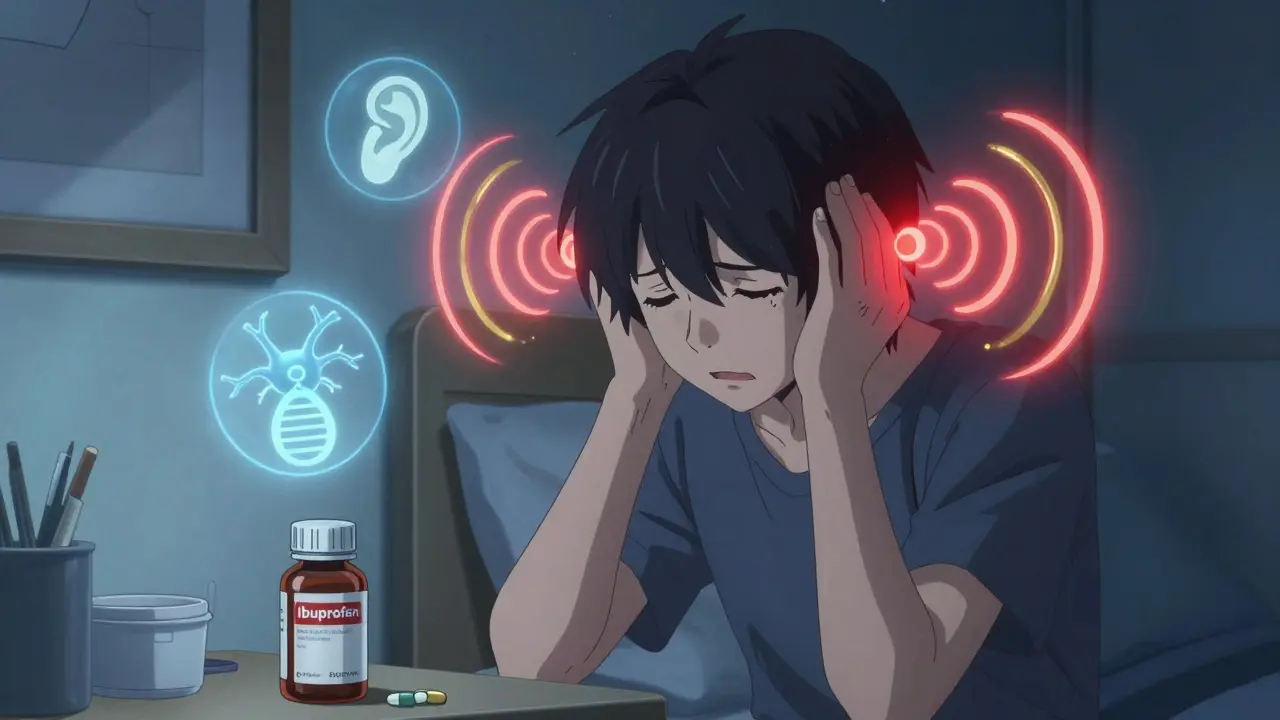
Many people notice a ringing, buzzing, or hissing in their ears after starting a new medication. It’s not just in their head - it’s a real side effect called medication-induced tinnitus. And while it’s often temporary, it can also be a warning sign of permanent hearing damage. The good news? Most cases can be reversed if caught early. The bad news? Many doctors don’t screen for it, and patients aren’t told what to watch for.
What Exactly Is Medication-Induced Tinnitus?
Tinnitus isn’t a disease. It’s a symptom - the feeling of hearing sound when no external noise is present. For some, it’s a soft hum. For others, it’s a loud, piercing ring that won’t go away. When it’s caused by a drug, it’s called ototoxicity. That means the medication is damaging parts of your inner ear or the nerve that sends sound signals to your brain. More than 600 prescription and over-the-counter drugs are known to cause or worsen tinnitus, according to Sound Relief’s 2025 review. That includes common pills you might take for headaches, infections, depression, or even acne. The damage can happen fast - sometimes within hours - or slowly, over months. What makes it tricky is that not everyone reacts the same way. One person might get ringing after a single high-dose ibuprofen, while another takes aspirin daily with no issues.Which Medications Are Most Likely to Cause Ringing in the Ears?
Not all drugs carry the same risk. Some are high-risk. Others are rare offenders. Here’s a breakdown of the most common culprits:- High-dose aspirin and NSAIDs: Taking more than 4,000 mg of aspirin a day can cause tinnitus in about 15% of people. But don’t panic - regular headache doses (325-650 mg) almost never cause it. Same goes for ibuprofen and naproxen. A Reddit user reported ringing after taking 800 mg of ibuprofen three times a day for dental pain. The sound faded within a week after stopping.
- Aminoglycoside antibiotics: Drugs like gentamicin and tobramycin, often given intravenously for serious infections, carry the highest risk. Up to 25% of patients on long-term treatment develop permanent hearing loss or tinnitus. Topical versions (eye drops, creams) are much safer.
- Chemotherapy drugs: Cisplatin, used for lung, ovarian, and testicular cancers, causes ototoxicity in 30-70% of patients. Hearing loss usually starts with high-pitched sounds first - you might miss birds chirping or doorbells before noticing trouble with speech.
- Loop diuretics: Furosemide (Lasix) and bumetanide, used for heart failure or kidney issues, can trigger tinnitus, especially at high doses or in people with kidney problems.
- Antimalarials: Quinine, sometimes used for leg cramps or malaria, can cause tinnitus within 24-72 hours. It usually goes away after stopping, but not always.
- Isotretinoin (Accutane): This acne drug causes tinnitus in about 5% of users, though the manufacturer claims less than 1%. Many patients report it after months of use.
- Antidepressants and benzodiazepines: These are lower-risk. Tinnitus is rare - affecting less than 1% of users. But some people report ringing when starting or stopping SSRIs like sertraline (Zoloft). In those cases, it’s often tied to withdrawal, not the drug itself.
Is the Damage Permanent?
It depends on the drug. About 60% of medication-induced tinnitus cases reverse completely once you stop the drug. But some drugs are permanent threats. Aminoglycosides and cisplatin can destroy the hair cells in your inner ear. These cells don’t regenerate. Once they’re gone, the ringing won’t fade. That’s why doctors monitor kidney function and hearing during treatment - they’re trying to catch damage before it’s irreversible. Even with low-risk drugs, a small group of people are unusually sensitive. Tinnitus.org.uk notes that a tiny fraction of people develop ringing from low-dose aspirin. If you’ve had tinnitus after taking any medication before, you might be one of them.
How Do You Know It’s the Medication?
Timing matters. Most people notice tinnitus within two weeks of starting a new drug. Some feel it after just 48 hours. Others don’t notice it until they’ve been on it for months. Ask yourself:- Did the ringing start after I began a new pill?
- Did it get worse when I increased the dose?
- Did it improve after I stopped the drug?
What Should You Do If You Notice Ringing?
Step one: Don’t panic. Step two: Don’t quit your meds without talking to your prescriber. Many conditions - high blood pressure, depression, infections - need treatment. Stopping a drug suddenly can be dangerous. Instead, schedule a quick chat with your doctor. Say: “I’ve noticed ringing in my ears since I started [drug name]. Could this be related?” Your doctor might:- Switch you to a different drug with lower ototoxic risk
- Lower your dose
- Order a hearing test to check for damage
- Refer you to an audiologist
Can You Prevent It?
Prevention starts with awareness. If you’re prescribed a drug known for ototoxicity, ask:- “Is there a safer alternative?”
- “Will I need hearing tests during treatment?”
- “What symptoms should I report right away?”





Reviews
Been dealing with this since I started sertraline. Thought I was going crazy until I read this. Stopped the meds cold turkey and the ringing got worse for a week-then faded. My audiologist said it’s classic SSRI withdrawal ototoxicity. Don’t quit without supervision, but DO push for a baseline audiogram if you’re on long-term meds. 🙏
Oh wow, a whole article about tinnitus and nobody mentioned that the real culprit is just… modern life? We’re all just vibrating at the wrong frequency now. Also, aspirin? Please. I’ve been popping 800mg ibuprofen like M&Ms since 2017 and my ears still sing opera. Must be the wifi.
THIS IS WHY YOU DON’T TRUST DOCTORS. I took Accutane for 8 months. Ringing started at month 5. I asked my dermatologist. He laughed. Said it was ‘stress.’ I had a full hearing test two weeks after quitting-permanent high-frequency loss. Now I can’t hear my own kid calling me. And you want me to ‘talk to my doctor’? My doctor is a glorified prescription machine. 🤬
Thank you for writing this!! 💖 I’m an audiologist and I see this ALL the time. Patients come in saying ‘I just woke up with this noise’-and it’s always tied to a new med. We need more awareness. If you’re on anything on this list and hear a new sound? Text your doc right now. Not tomorrow. Right now. And if they brush you off? Get a second opinion. Your ears are worth it. 🎧❤️
Look i know this sounds like a conspiracy but i think the real issue is that pharma companies dont want us to know how many drugs fry your ears because then people would stop taking them and theyd lose billions. Like cisplatin? 70% of patients get deaf? And they still use it? Because cancer > hearing. But what about the other 90% of meds on this list? Why arent they being pulled? Why is aspirin still on the shelf? This is pure greed. And your doctor is paid to look the other way. I read a paper once that said the FDA gets 30% of its funding from drug companies. Thats not a coincidence. Thats a crime.
So you’re telling me that after decades of people complaining about tinnitus from meds, we’re only now getting a ‘comprehensive’ list? This isn’t news. This is negligence. And the fact that you’re treating this like some ‘awareness campaign’ instead of a systemic failure is why people die. You don’t ‘talk to your doctor’-you sue the hospital. You demand a hearing protocol. You demand informed consent. This isn’t ‘be your own advocate’-it’s ‘demand your rights’.
My cousin in Lagos had tinnitus after taking antibiotics for malaria. Doctor said it will go. It didn’t. Now he uses hearing aid. People in Nigeria don’t know this. We need more education. Not just in America. In Africa too. Thank you for sharing.
So what? I’ve had tinnitus since I was 12. Probably from listening to too much Nirvana. This article is just fearmongering. Stop being so sensitive.
OTOTOXICITY. That’s the word. You’re all missing the clinical term. The real issue isn’t the meds-it’s the lack of pharmacogenomic screening. We’re dosing people based on weight and age, not metabolic pathways. CYP2D6 polymorphisms explain why some people get tinnitus from 325mg aspirin and others don’t. This isn’t luck. It’s biochemistry. And no, your doctor doesn’t know this. They were taught in 1998.
Wait, so the same guy who says ‘just talk to your doctor’ is also the one who wrote the entire 2000-word post about how doctors don’t screen for this? That’s like writing a 10-page essay on how your mechanic is terrible… and then telling people to ‘just ask your mechanic.’
My uncle in India was on loop diuretics for heart failure. He started hearing his own heartbeat in his ears. We didn’t know it was the medicine. He thought he was going mad. After switching meds, the ringing faded. This is real. Please share this with older folks. They don’t read Reddit. But they trust family. 🙏
Hey! I’m from India too. We call this ‘kana kana’ sound-like crickets in your head. My mom got it after antibiotics. She didn’t tell anyone for months because she thought it was ‘normal.’ Now she uses a white noise app at night. It helps. Thanks for writing this-it’s nice to see people talking about it.
OMG I’ve been hearing this high-pitched whine for 3 months and thought I was losing my mind 😭 I just started Zoloft 2 months ago. I was gonna quit but now I’m calling my doc tomorrow. I’m not crazy. It’s the meds. Thank you for this. I feel less alone. 💕
So… what’s the point? We’re all gonna die. Your ears? Your brain? Your soul? It’s all just noise. The universe is a feedback loop. The ringing… it’s not in your ears. It’s the sound of existence itself. You’re just finally hearing the static between the stars. 🌌
You think this is bad? Wait until you’re on 12 different meds for your autoimmune disorder, depression, high blood pressure, acid reflux, sleep apnea, and chronic pain-and your ENT says ‘maybe try a hearing aid’ while you’re still taking cisplatin and furosemide. This isn’t ‘awareness.’ This is a slow-motion medical massacre. And the worst part? The people who need this info the most-elderly, low-income, non-English speakers-are the ones who’ll never see it. So yeah. Keep posting. But don’t pretend this is a ‘solution.’ It’s just another drop in the ocean of neglect.